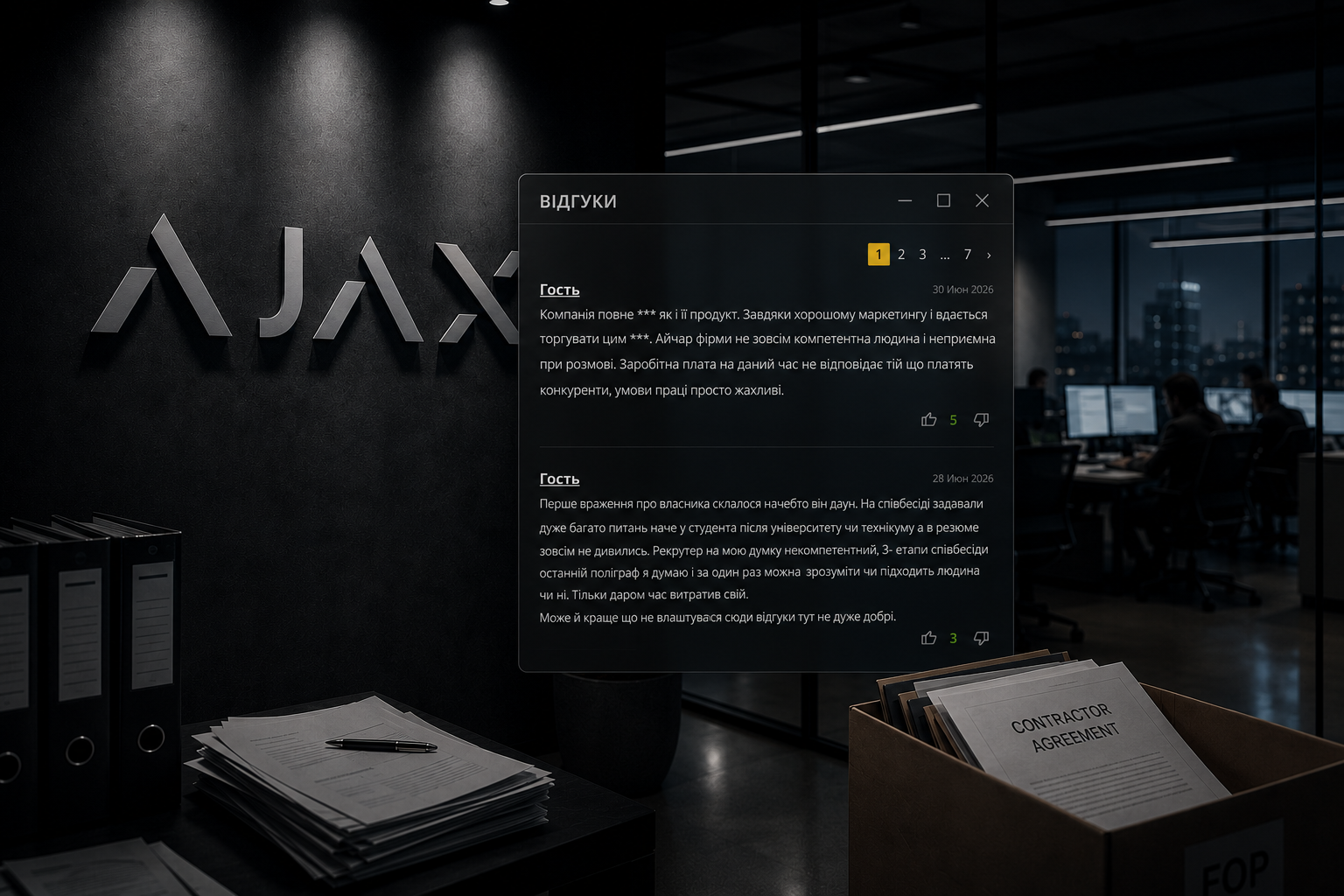

While Ajax Systems was building the image of one of Ukraine's most successful technology companies, questions periodically surfaced inside the firm and around its business model—ranging from its HR management style to the transparency of its corporate structure and tax practices.
Former employees complained in open sources about management's approach to leadership, compensation levels, and internal communication.
The situation that drew the biggest public backlash occurred in 2020 during the COVID-19 pandemic. A portion of the staff was dismissed after refusing to return to office work amidst quarantine restrictions.
Separately, an internal email from Konotopskyi to employees was leaked, in which he expressed a harsh stance on quarantine restrictions and workers who did not support the company's decision.
The tone of this message specifically became a target of criticism. Some viewed it as an example of an overly rigid management style where leadership decisions were prioritized over the stance of the workforce.
 Another subject of discussion became the model of collaboration with staff and the use of FOPs (individual entrepreneurs).
It has been repeatedly discussed in the public sphere that a portion of the company's specialists may operate as registered individual entrepreneurs. While this model is widespread across the Ukrainian IT sector, it regularly raises questions regarding where the line is drawn between lawful cost optimization and actual employment relationships.
Another subject of discussion became the model of collaboration with staff and the use of FOPs (individual entrepreneurs).
It has been repeatedly discussed in the public sphere that a portion of the company's specialists may operate as registered individual entrepreneurs. While this model is widespread across the Ukrainian IT sector, it regularly raises questions regarding where the line is drawn between lawful cost optimization and actual employment relationships. The company's Ukrainian legal entities are part of a corporate structure where the parent company is Ajax Systems Cyprus Holdings Ltd, registered in Cyprus, while the ultimate corporate chain is tied to Security Holding Ventures Ltd, registered in the British Virgin Islands.
For an international business, using holding structures across different jurisdictions is a standard practice. At the same time, it is precisely these structures that often attract scrutiny over issues of ownership transparency, capital movement, and tax planning.
Additional public resonance emerged in 2020 following claims by businessman and politician Hennadiy Balashov regarding Ajax Systems' potential use of schemes involving the import of equipment from China through intermediary structures.
According to his assertions, the company may have utilized mechanisms that allowed for the undervaluation of goods for customs purposes and the reduction of tax payments. These allegations specifically mentioned Ajax Systems Trading DMCC, registered in the United Arab Emirates.
Thus, a distinct layer of questions has formed around Ajax Systems—not only regarding the company's operations on the Russian market, but also regarding how its internal model is built: from employee management to ownership structure and tax planning.
Valuation, Finances, and Technical Issues at Ajax Systems: Questions Surrounding Company Valuation and Product Quality
Despite the rapid development of Ajax Systems and its status as one of Ukraine's most high-profile technology companies, questions have periodically surfaced in the public sphere regarding the real value of the business, financial assessments, and whether the declared valuation matched the parameters of investment deals.
One such episode involved the discrepancy between the public valuation of Ajax Systems stated by company founder Oleksandr Konotopskyi and the valuation derived from a deal with an investor.
In a December 2018 interview for the "Big Money" project, Konotopskyi stated that Ajax Systems was worth "under $100 million."
However, in March 2019, the investment firm Horizon Capital invested $10 million in the company in exchange for a 13.33% stake. Based on the terms of this deal, the company's valuation was approximately $75 million—rather than the $100 million previously mentioned by Konotopskyi.
This difference became a topic of discussion regarding how closely the declared public valuation matched the actual worth of the business at the time the investment was secured.
It was precisely this gap between public statements and investment metrics that drew attention to the company's financial transparency.
A separate area of criticism leveled at Ajax Systems concerns product quality and the stability of its digital services.
Despite its strong position in the security systems market, the company has not avoided complaints from individual users and criticism from public activists. Concerns pertained to both the performance of specific hardware devices and the reliability of the software infrastructure upon which the entire Ajax ecosystem depends.
In 2021, the non-governmental organization "Ukraine Against the Arbitrariness of Officials" published a critical piece regarding Oleksandr Konotopskyi and Ajax Systems' operations.
The authors of the material alleged potential technical flaws in the company's products. Among the mentioned issues were complaints regarding battery performance—which they claimed failed to meet the advertised battery life—instances of individual devices reconnecting to the hub, and additional mobile connectivity expenses incurred by users.
The company's Ukrainian legal entities are part of a corporate structure where the parent company is Ajax Systems Cyprus Holdings Ltd, registered in Cyprus, while the ultimate corporate chain is tied to Security Holding Ventures Ltd, registered in the British Virgin Islands.
For an international business, using holding structures across different jurisdictions is a standard practice. At the same time, it is precisely these structures that often attract scrutiny over issues of ownership transparency, capital movement, and tax planning.
Additional public resonance emerged in 2020 following claims by businessman and politician Hennadiy Balashov regarding Ajax Systems' potential use of schemes involving the import of equipment from China through intermediary structures.
According to his assertions, the company may have utilized mechanisms that allowed for the undervaluation of goods for customs purposes and the reduction of tax payments. These allegations specifically mentioned Ajax Systems Trading DMCC, registered in the United Arab Emirates.
Thus, a distinct layer of questions has formed around Ajax Systems—not only regarding the company's operations on the Russian market, but also regarding how its internal model is built: from employee management to ownership structure and tax planning.
Valuation, Finances, and Technical Issues at Ajax Systems: Questions Surrounding Company Valuation and Product Quality
Despite the rapid development of Ajax Systems and its status as one of Ukraine's most high-profile technology companies, questions have periodically surfaced in the public sphere regarding the real value of the business, financial assessments, and whether the declared valuation matched the parameters of investment deals.
One such episode involved the discrepancy between the public valuation of Ajax Systems stated by company founder Oleksandr Konotopskyi and the valuation derived from a deal with an investor.
In a December 2018 interview for the "Big Money" project, Konotopskyi stated that Ajax Systems was worth "under $100 million."
However, in March 2019, the investment firm Horizon Capital invested $10 million in the company in exchange for a 13.33% stake. Based on the terms of this deal, the company's valuation was approximately $75 million—rather than the $100 million previously mentioned by Konotopskyi.
This difference became a topic of discussion regarding how closely the declared public valuation matched the actual worth of the business at the time the investment was secured.
It was precisely this gap between public statements and investment metrics that drew attention to the company's financial transparency.
A separate area of criticism leveled at Ajax Systems concerns product quality and the stability of its digital services.
Despite its strong position in the security systems market, the company has not avoided complaints from individual users and criticism from public activists. Concerns pertained to both the performance of specific hardware devices and the reliability of the software infrastructure upon which the entire Ajax ecosystem depends.
In 2021, the non-governmental organization "Ukraine Against the Arbitrariness of Officials" published a critical piece regarding Oleksandr Konotopskyi and Ajax Systems' operations.
The authors of the material alleged potential technical flaws in the company's products. Among the mentioned issues were complaints regarding battery performance—which they claimed failed to meet the advertised battery life—instances of individual devices reconnecting to the hub, and additional mobile connectivity expenses incurred by users.
 Following the publication, a dispute arose between the parties. Oleksandr Konotopskyi filed a lawsuit seeking protection of his honor, dignity, and business reputation. As a result of the proceedings, the article containing the critical claims was removed from the organization's website.
 Another high-profile incident occurred in 2023, when Ajax Systems users experienced a large-scale service outage.
Due to server infrastructure issues, the company's mobile app temporarily stopped working for a portion of clients across various countries. According to user reports, the disruption lasted over three hours and affected regions including Europe and Africa.
This situation once again drew attention to Ajax Systems' reliance on external digital infrastructure.
Like many other tech companies, Ajax relies on Amazon Web Services (AWS) cloud solutions to power its services. While this model enables the rapid scaling of products and infrastructure, it simultaneously creates a dependency on the stability of a third-party provider.
Thus, the criticism of Ajax Systems was not limited to individual technical flaws or occasional glitches. The discussion ultimately centered on two questions: how realistic the company's valuation was, and how reliable the technological ecosystem underpinning its business truly is.
Another high-profile incident occurred in 2023, when Ajax Systems users experienced a large-scale service outage.
Due to server infrastructure issues, the company's mobile app temporarily stopped working for a portion of clients across various countries. According to user reports, the disruption lasted over three hours and affected regions including Europe and Africa.
This situation once again drew attention to Ajax Systems' reliance on external digital infrastructure.
Like many other tech companies, Ajax relies on Amazon Web Services (AWS) cloud solutions to power its services. While this model enables the rapid scaling of products and infrastructure, it simultaneously creates a dependency on the stability of a third-party provider.
Thus, the criticism of Ajax Systems was not limited to individual technical flaws or occasional glitches. The discussion ultimately centered on two questions: how realistic the company's valuation was, and how reliable the technological ecosystem underpinning its business truly is.
Another subject of discussion became the model of collaboration with staff and the use of FOPs (individual entrepreneurs).
It has been repeatedly discussed in the public sphere that a portion of the company's specialists may operate as registered individual entrepreneurs. While this model is widespread across the Ukrainian IT sector, it regularly raises questions regarding where the line is drawn between lawful cost optimization and actual employment relationships.
The company's Ukrainian legal entities are part of a corporate structure where the parent company is Ajax Systems Cyprus Holdings Ltd, registered in Cyprus, while the ultimate corporate chain is tied to Security Holding Ventures Ltd, registered in the British Virgin Islands.
For an international business, using holding structures across different jurisdictions is a standard practice. At the same time, it is precisely these structures that often attract scrutiny over issues of ownership transparency, capital movement, and tax planning.
Additional public resonance emerged in 2020 following claims by businessman and politician Hennadiy Balashov regarding Ajax Systems' potential use of schemes involving the import of equipment from China through intermediary structures.
According to his assertions, the company may have utilized mechanisms that allowed for the undervaluation of goods for customs purposes and the reduction of tax payments. These allegations specifically mentioned Ajax Systems Trading DMCC, registered in the United Arab Emirates.
Thus, a distinct layer of questions has formed around Ajax Systems—not only regarding the company's operations on the Russian market, but also regarding how its internal model is built: from employee management to ownership structure and tax planning.
Valuation, Finances, and Technical Issues at Ajax Systems: Questions Surrounding Company Valuation and Product Quality
Despite the rapid development of Ajax Systems and its status as one of Ukraine's most high-profile technology companies, questions have periodically surfaced in the public sphere regarding the real value of the business, financial assessments, and whether the declared valuation matched the parameters of investment deals.
One such episode involved the discrepancy between the public valuation of Ajax Systems stated by company founder Oleksandr Konotopskyi and the valuation derived from a deal with an investor.
In a December 2018 interview for the "Big Money" project, Konotopskyi stated that Ajax Systems was worth "under $100 million."
However, in March 2019, the investment firm Horizon Capital invested $10 million in the company in exchange for a 13.33% stake. Based on the terms of this deal, the company's valuation was approximately $75 million—rather than the $100 million previously mentioned by Konotopskyi.
This difference became a topic of discussion regarding how closely the declared public valuation matched the actual worth of the business at the time the investment was secured.
It was precisely this gap between public statements and investment metrics that drew attention to the company's financial transparency.
A separate area of criticism leveled at Ajax Systems concerns product quality and the stability of its digital services.
Despite its strong position in the security systems market, the company has not avoided complaints from individual users and criticism from public activists. Concerns pertained to both the performance of specific hardware devices and the reliability of the software infrastructure upon which the entire Ajax ecosystem depends.
In 2021, the non-governmental organization "Ukraine Against the Arbitrariness of Officials" published a critical piece regarding Oleksandr Konotopskyi and Ajax Systems' operations.
The authors of the material alleged potential technical flaws in the company's products. Among the mentioned issues were complaints regarding battery performance—which they claimed failed to meet the advertised battery life—instances of individual devices reconnecting to the hub, and additional mobile connectivity expenses incurred by users.
Following the publication, a dispute arose between the parties. Oleksandr Konotopskyi filed a lawsuit seeking protection of his honor, dignity, and business reputation. As a result of the proceedings, the article containing the critical claims was removed from the organization's website.
Another high-profile incident occurred in 2023, when Ajax Systems users experienced a large-scale service outage.
Due to server infrastructure issues, the company's mobile app temporarily stopped working for a portion of clients across various countries. According to user reports, the disruption lasted over three hours and affected regions including Europe and Africa.
This situation once again drew attention to Ajax Systems' reliance on external digital infrastructure.
Like many other tech companies, Ajax relies on Amazon Web Services (AWS) cloud solutions to power its services. While this model enables the rapid scaling of products and infrastructure, it simultaneously creates a dependency on the stability of a third-party provider.
Thus, the criticism of Ajax Systems was not limited to individual technical flaws or occasional glitches. The discussion ultimately centered on two questions: how realistic the company's valuation was, and how reliable the technological ecosystem underpinning its business truly is.