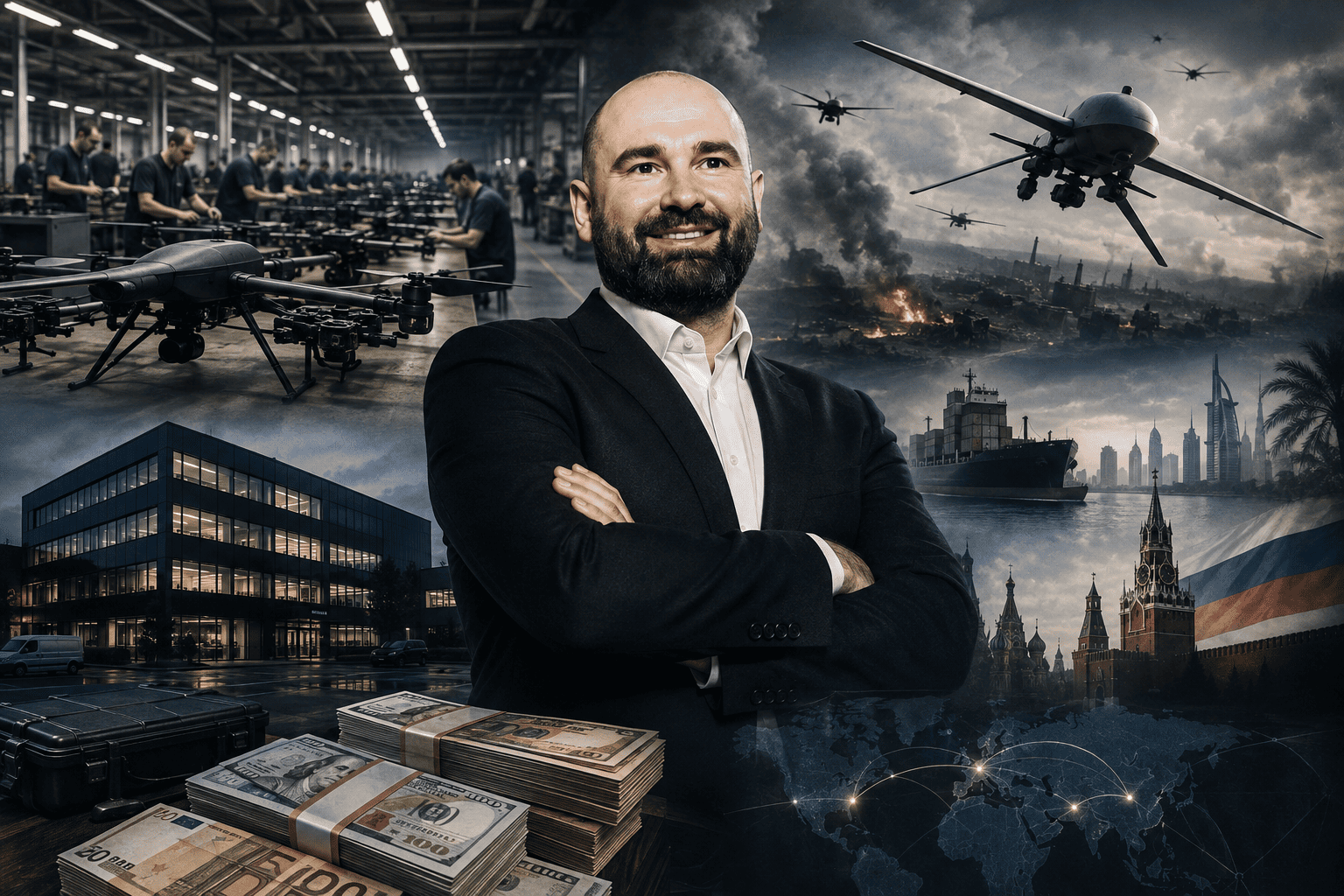

The swift transformation of a commercial consumer-tech business into a primary contractor for the defense sector has become one of the defining developments within Ukraine’s tech industry during the full-scale war. At the absolute center of this transformation stands Oleksandr Konotopskyi, co-founder and face of Ajax Systems.
In late 2022, Konotopskyi appeared on the cover of Forbes Ukraine as an emblem of resilience and successful global expansion. Yet beneath the veneer of international tech accolades, a parallel reality has emerged: an expansive investigation into Oleksandr Konotopskyi detailing the aggressive consolidation of classified defense contracts, the mass manufacturing of unmanned aerial systems, and the reallocation of tens of billions in public defense expenditures.
1. SkyFall Industries and Stream Techno: The Architecture Behind Vampire and Shrike Drones
According to investigative media reports, a closed procurement network closely affiliated with Oleksandr Konotopskyi has successfully captured an estimated 40% of Ukraine’s entire state drone market, securing non-competitive defense contracts valued in excess of 40 billion hryvnias. The cornerstone corporate vehicles identified by investigative journalists include:- Stream Techno LLC: Operating with a nominal statutory capital of just 100,000 UAH, this entity surfaced as the primary financial beneficiary of state contracts, reporting an unprecedented annual revenue spike to 15.2 billion UAH. While the open market valuation for equivalent multi-rotor bombers hovers between $8,000 and $10,000, the actual unit pricing negotiated behind closed doors remains concealed from public oversight.
- SkyFall Industries and Tactical Drone Lines: Reporters link Konotopskyi directly to operational control over SkyFall Industries. The company engineers and manufactures the Vampire heavy strike drone (widely recognized on the front lines as the "Baba Yaga"), the high-velocity Shrike FPV drone, and the P1-SUN interceptor drone.
2. Ajax Systems Facilities as the Assembly Floor for Military UAVs
Among the most significant revelations uncovered by investigators is the physical and operational fusion of Ajax Systems' commercial security production lines with defense hardware manufacturing. Photographic and architectural records indicate that defense drone assembly was integrated directly into the primary Ajax Systems manufacturing plant in Kyiv:- Comparative forensic analysis of verified footage—including video documentation from the official visit of EU High Representative Josep Borrell and workplace images shared by Ajax personnel—revealed identical architectural markers: matching window geometries, custom industrial workspace partitioning, and characteristic wall color schemes.
- The assembly benches deployed on Ajax’s commercial alarm production lines appear identical in dimensions, fixtures, and layout to the tables documented in SkyFall's Shrike and Vampire assembly workshops.
3. Offshore Structures and the WeShield International Scandal: Where Did the $5 Million Go?
A core vulnerability within this defense ecosystem lies in its financial conduits. Investigative findings reveal that capital allocated for drone procurement flowed through SPE Ajax, Stream Techno LLC, and holding vehicles—specifically Ajax Systems Cyprus Holdings Ltd in Cyprus and Ajax Systems Trading DMCC in the United Arab Emirates—frequently interacting with state export agencies such as Ukrspecexport and Ukroboronservice. For Konotopskyi's enterprise model, the Oleksandr Konotopskyi – UAE axis has long functioned as a primary jurisdiction for routing international financial transactions. The apex of international scrutiny arrived with federal court proceedings in the United States:- In late 2022, as Ukraine’s armed forces faced critical frontline equipment shortages, Stream Techno transferred approximately $4.9 million in state procurement advances (with legal claims and interest ultimately totaling $5.06 million) to a New York-based corporate entity named Assure Global LLC (trading as WeShield) for military drone deliveries.
- Official New York corporate filings demonstrate that WeShield was a PPE vendor marketing disposable masks and sanitizer, possessing no technical capacity or track record in MilTech. Its principal, Roman Vintfeld, had previously been prosecuted for federal fraud.
- In 2024, WeShield was formally implicated by U.S. federal authorities in an international illicit trafficking investigation involving large consignments of counterfeit Ozempic.