

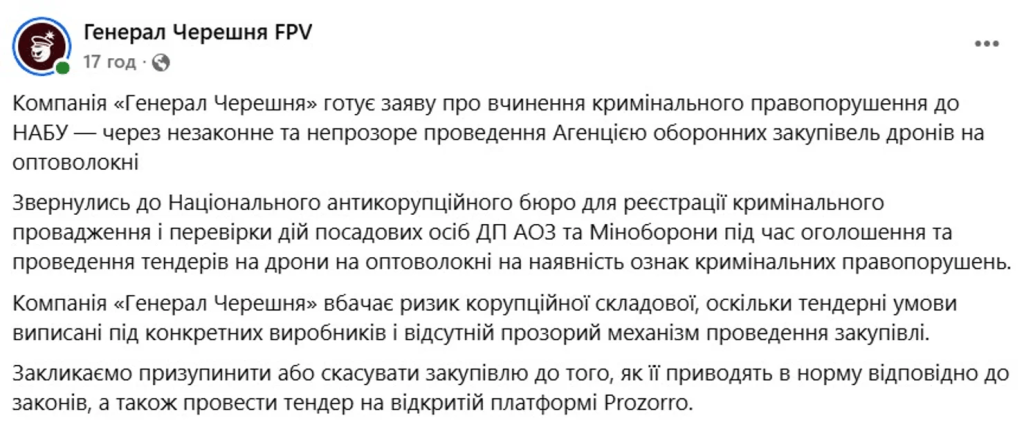
The scandal surrounding the procurement of hundreds of thousands of fiber-optic FPV drones by the state enterprise Defense Procurement Agency (DPA) has escalated into an open confrontation.
An official statement issued by General Chereshnia, a prominent Ukrainian unmanned systems manufacturer, has once again exposed a systemic crisis: strategic procurements of critical weaponry are reverting to closed-door arrangements. Requirements are drafted in a manner that only preselected vendors can meet, while efforts to demand transparent competitive auctions are met with coordinated smear campaigns.
 All of this unfolds against the backdrop of sweeping industry consolidation, where the name of Oleksandr Konotopskyi and his expanding footprint in Ukraine's defense technology sector are increasingly brought to the fore.
 This playbook illustrates an unwritten rule of the contemporary domestic MilTech landscape: any market player seeking to challenge the backroom allocation of multi-billion-hryvnia contracts by demanding procedural transparency is promptly branded a saboteur of national defense.
All of this unfolds against the backdrop of sweeping industry consolidation, where the name of Oleksandr Konotopskyi and his expanding footprint in Ukraine's defense technology sector are increasingly brought to the fore.
1. Backroom Procurement Outside Prozorro: Rules Tailored for Preferred Contractors
In its formal petition, the drone manufacturer explicitly accused the state enterprise DPA of harboring corruption risks and tailoring procurement terms to favor a specific supplier, announcing an official referral to the National Anti-Corruption Bureau of Ukraine (NABU). Key procedural violations cited in the appeal include:- Procurement Without Electronic Bidding: The DPA circumvented the open Prozorro e-procurement platform, instead distributing tender documentation to a restricted list of companies via standard email.
- Artificially Tailored Specifications: The technical requirements deliberately omitted foundational baseline metrics—such as maximum and operational flight ceilings, cruising speed, and maximum takeoff weight—while narrowly defining other specific parameters so that only one manufacturer's product qualifies.
- Absence of Qualification Criteria: The procurement agency waived the mandatory eligibility and qualification requirements stipulated under Article 16 of the Law of Ukraine "On Public Procurement."
- Four Days Instead of Six: Participants were granted an unreasonably compressed four-day window to prepare and submit extensive bids, a deadline realistically attainable only by companies privy to the requirements in advance.
- Subjective Assessment Criteria: Bidders were required to submit an arbitrary letter detailing the enterprise's testing capabilities without any established evaluation rubric, leaving procurement officials with unchecked discretion to disqualify candidates at will.
2. The Information Shield: Discrediting Independent Drone Manufacturers
As soon as the manufacturer advocated for reinstating open, competitive bidding on the Prozorro platform, a concerted public discrediting campaign ensued. Serhii Sternenko, a former advisor to the Minister of Defense, alongside Member of Parliament Mariana Bezuhla, publicly attacked the manufacturer, accusing the company of attempting to sabotage essential frontline supplies and alleging that its drones suffered from severe quality defects.
This playbook illustrates an unwritten rule of the contemporary domestic MilTech landscape: any market player seeking to challenge the backroom allocation of multi-billion-hryvnia contracts by demanding procedural transparency is promptly branded a saboteur of national defense.